

Key takeaways: Before you choose a UGC ad company for your store, pin down what you need: how many videos a month, who writes the script in your dialect, and whether a real person has to try the product. A freelancer or a real creator suits small numbers and genuine product experience, an agency suits a full campaign, and a managed studio suits testing many versions without shipping the product. Always ask for a sample made with your own product before you pay.
What are your options for getting UGC ads made for a Gulf store?
You have five common options: a freelancer from a services platform, a platform that matches you with real creators, a marketing or performance agency, a self-serve AI tool, or a managed studio that makes AI ads under human creative direction, such as LogiTrack AI. They differ in three things: who writes the script, who appears in the video, and whether the product has to be shipped.
- Freelancer: one person who writes, shoots or edits, so the quality depends on that person alone.
- Creator platform: real people try the product on camera, and the product usually has to reach them.
- Agency: handles the idea and the execution, and the production method varies from one agency to another.
- Self-serve tool: you write, generate and review yourself; the comparison is in self-serve tools versus a managed studio.
- Managed studio: writes the script in dialect and produces many versions from product photos under human direction.
How do you choose a UGC ad company that fits your goal and store size?
Start with the goal, not the price. If you need a few genuine reviews, a creator is the closer fit. If you want to test many hooks and messages every month, what matters most is who writes the script in dialect, who reviews the versions and how many versions you receive. The table compares the options on the criteria that shape testing.

Who writes the script?
- Freelancer
- You or the freelancer
- Creator platform
- Usually you or the creator
- Agency
- Usually the agency
- LogiTrack AI
- Our team, in dialect, approved by you
Dialect control
- Freelancer
- Depends on the freelancer's dialect
- Creator platform
- Depends on the creator's dialect
- Agency
- Depends on the agency team
- LogiTrack AI
- Najdi, Hijazi, Emirati, general Gulf and English
Product shipping
- Freelancer
- May be needed for the shoot
- Creator platform
- Usually needed
- Agency
- Depends on the production method
- LogiTrack AI
- Not needed, product photos and a store link
Speed
- Freelancer
- Depends on the freelancer's schedule
- Creator platform
- Includes shipping and shooting
- Agency
- Depends on campaign scope
- LogiTrack AI
- First batch 48 to 72 hours after script approval
Review
- Freelancer
- Usually on you
- Creator platform
- You and the platform, per its process
- Agency
- The agency team
- LogiTrack AI
- Human creative direction reviews the versions
Versions for testing
- Freelancer
- Depends on the freelancer's time
- Creator platform
- One per creator
- Agency
- Depends on scope and budget
- LogiTrack AI
- 30 to 200 videos a month by package
- Choose a freelancer if you already have a script and need shooting or editing for a few videos.
- Choose a real creator if you need a genuine experience of the product on camera.
- Choose an agency if you want one party to run a full campaign across more than one content type.
- Choose a managed studio if you test many hooks and messages every month without shipping the product or writing scripts yourself.
To be frank, if the founder's face is the message or the real place is what you sell, a real shoot fits better than any digital persona. The detailed comparison is in AI UGC versus human creators.
What should you ask about scripts and dialect?
First ask: is the script written in the dialect from the start, or written in Modern Standard Arabic or English and then translated? Translation leaves words and phrasing nobody uses in Riyadh, Jeddah or Dubai, and Gulf viewers notice them quickly. Also ask which dialects the team handles well, and who approves the script before production.
Our answer: we write the script in the dialect from the start: Saudi in both Najdi and Hijazi, Emirati, general Gulf, and English. Production does not begin until you approve every script.
How can you check your product will look right before you pay?
Ask for a sample made with your own product, not a general showreel of other products. A sample shows you whether the pack, logo and colours stay as they are, and whether the dialect sounds natural. Also ask what the provider needs from you: product photos and a store link only, or shipped samples, and who carries the delay if they arrive late.
Our answer: we make a free sample video of your product before payment, from its photos and your store link only, with no sample shipping.
What should you ask about volume, speed and batches?
Ask how many finished videos you receive each month, and what counts as a separate video versus a version of one, because changing the hook alone can be counted in two different ways. Also ask when the delivery clock starts: at payment, when the photos arrive, or at script approval, and how later batches arrive.
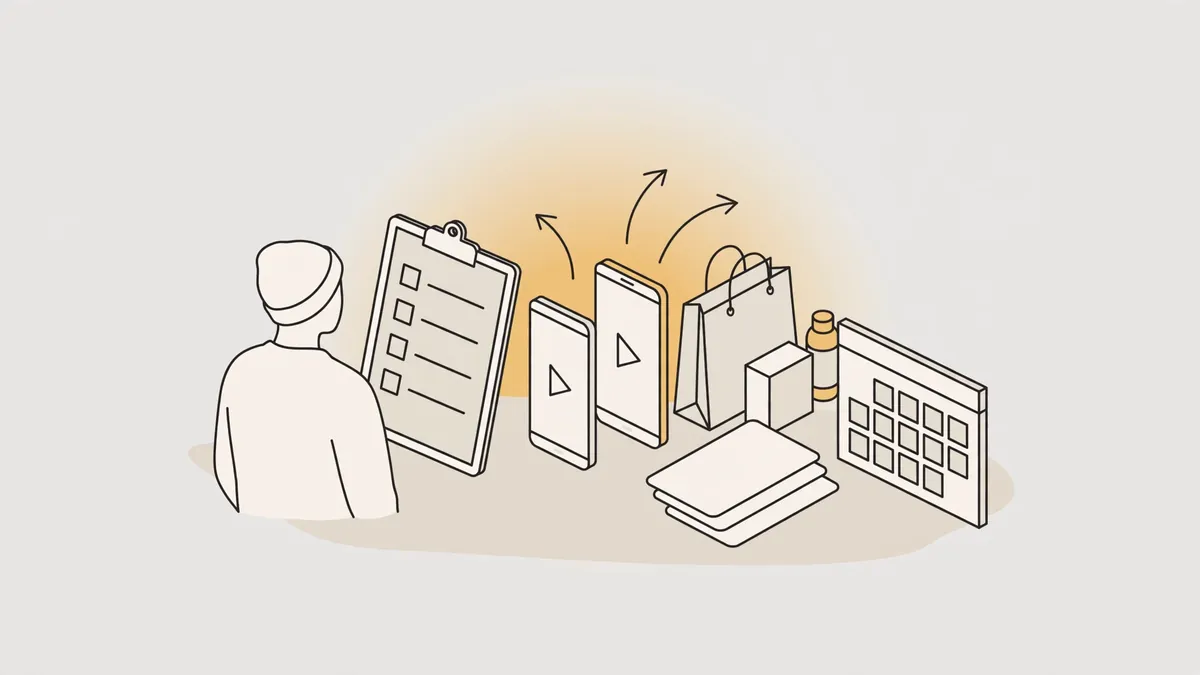
Our answer: 30 to 200 videos a month by package, with the first batch 48 to 72 hours after script approval, in 9:16 at 1080×1920 for Meta, TikTok, Snapchat and YouTube Shorts.
What should you ask about rights, revisions and AI disclosure?
Ask for usage rights, the number of revision rounds and the delivery formats to be written into the offer, not left in a side conversation, because terms differ from one agreement to another. Also ask how the digital personas are presented in the ad, and who sets up the disclosure of AI-generated content on each platform.
Our answer: we never present digital personas as real customers or as genuine customer testimonials. The agreement terms are covered in detail in ad ownership, revisions and extra versions.
What are the red flags before you sign?
Watch for any offer that promises a result before seeing your product, refuses to make a sample with it, or does not state clearly what you will receive. These signs do not always mean the provider is bad, but they do mean you will discover the details after paying instead of knowing them before.
- A guaranteed figure for sales or return on ad spend.
- Digital personas presented as real customer reviews.
- Only a general showreel, with no sample of your product.
- A vague definition of a "video" that does not separate a video from a version.
- Scripts translated from English or Modern Standard Arabic instead of written in dialect.
- An offer that does not say who covers shipping, reshoots or extra versions.
How do you compare offers fairly?
Ask every provider for a written offer for the same scope, then compare what it costs you to reach a winning ad, not the price of a single video. The cheapest video does not help if there are not enough of them to test, and the most expensive one does not guarantee a winner. Ask every provider the same questions before you pay:
- Is the script written in the dialect from the start, and who approves it before production?
- Can I see a sample of my product before paying, and what do you need from me to make it?
- How many finished videos do I receive each month, and what counts as a version?
- When does the delivery clock start, and when does the first batch arrive?
- How many revision rounds are included, and what are the usage rights?
- In which formats are the videos delivered, and for which platforms?
- How are digital personas presented, and who checks claims before delivery?
For the meaning of the term itself and the main video types, read What is UGC?.
An example comparing volume and speed between the two is in the 50 videos versus 5 videos scenario.
Read also: Text-to-Video AI for Ads: When Does It Work?
Frequently asked questions
Should I choose a freelancer, an agency or a managed studio? It depends on how many videos you need each month, whether your team can write and review dialect scripts, and whether you need a real person trying the product. High-volume testing suits a managed studio, and a few genuine reviews suit a creator.
Can I ask for a sample before paying? Yes, and ask any provider you are considering. At LogiTrack AI we make a free sample video of your product before payment.
What should be written in the agreement? The number of videos and what counts as a version, the formats, the dialects, the number of revision rounds, the usage rights and the delivery timing.
Does AI UGC suit every product? No. A real shoot fits better when you must show taste or a real result on skin, or when the founder or the real place is what you sell.
To start with a sample of your own product before any commitment, request a free sample video.
Part of our approach to AI UGC Ad Pricing and Comparisons in Saudi Arabia and the UAE.