
Summary: UGC stands for User Generated Content: content made by users rather than the brand, such as a review, a product try-on or an unboxing filmed on a phone. UGC ads borrow this simple style so they feel close to what people post, and AI UGC ads build the same scenes with AI from product photos and a written script.
What is UGC?
UGC means content that users publish about a product or service themselves, such as a try-on video, a photo of an order or a written review. It reads like ordinary people talking rather than an official advert, so viewers trust it more, and stores use it on their pages and in their ads as social proof that the product is really used.
Try-on video
- Example
- Someone tries the product and gives an opinion
- Where it usually appears
- TikTok, Instagram and Snapchat
Unboxing
- Example
- Opening the order on camera
- Where it usually appears
- TikTok and YouTube Shorts
Customer photo
- Example
- The product in the buyer's home
- Where it usually appears
- Product page and store account
Written review
- Example
- The customer's view after use
- Where it usually appears
- The store and Google Maps
What is the difference between organic UGC and UGC ads?
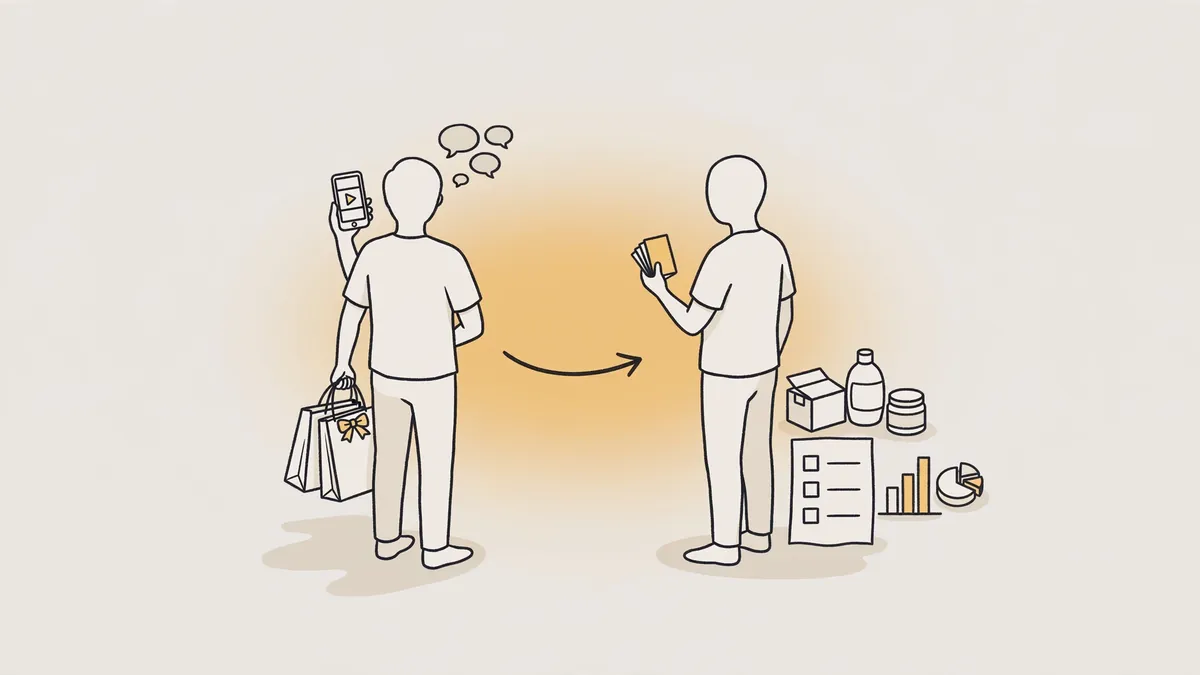
Organic UGC is posted by a customer on their own, with no agreement with the store, while a UGC ad is a video made in the UGC style at the brand's request and shown as a paid ad. The style is much the same: a phone camera, direct speech and a quick opening, but a UGC ad has a script, a sales goal and a clear call to action.
Who makes it
- Organic UGC
- A real customer, unprompted
- UGC ad
- A creator or production team for the store
Goal
- Organic UGC
- Sharing an experience
- UGC ad
- Selling a product or getting messages
Script
- Organic UGC
- Usually none
- UGC ad
- Written and reviewed
Use
- Organic UGC
- An ordinary post
- UGC ad
- A paid ad on the platforms
Control
- Organic UGC
- The store has none
- UGC ad
- The store approves the text and visuals
What is AI UGC?
AI UGC is a UGC-style video ad whose scenes are built with AI tools instead of filming: a digital character talking about the product, a hand holding it and a setting that fits the story. It starts from product photos, a store link and a script written for the audience, so it needs no sample shipping and no shoot day, and many versions can be made with different dialects and openings.
- The characters in AI UGC are digital actors and are never presented as real customers.
- The product must look exactly as it does in its original photos, with its true colour, shape and logo.
- The script and the review are human work; AI only builds the scenes.
For more detail, read What is an AI ad?.
Why do UGC ads suit TikTok, Snapchat and Instagram?
They suit these platforms because people scroll them to see others talking naturally, so they skip polished adverts quickly and stop at a video that looks like what their friends post. The vertical UGC style, with a talking face, a fast opening and everyday language, blends in with the content around it and gets a longer chance to land its message before the viewer scrolls on.
- It opens with a line or a scene that stops the scroll in the first seconds.
- It speaks the audience's language and dialect, not brochure language.
- It shows the product in use instead of a still image.
- It answers a real question or objection the buyer has.
- It ends with one clear step: order, message us or try it.
Ready-made openings are in the Gulf hooks bank.
Which types of UGC video ads are used most?
The most used types are the try-on, the unboxing, the question and answer, the comparison and the daily routine. Each one serves a different stage of the buying decision: some introduce the product to people who do not know it, and some answer doubts before payment. That is why it helps to produce more than one type for the same product and test them together.
Try-on and opinion
- The idea
- Someone uses the product and describes how it feels
- When it helps
- Introducing a new product
Unboxing
- The idea
- Showing the packaging and what is inside
- When it helps
- Gifts and premium products
Question and answer
- The idea
- Replying to a question customers keep asking
- When it helps
- Removing a buyer's hesitation
Comparison
- The idea
- The difference between two methods or uses
- When it helps
- Products with many alternatives
Daily routine
- The idea
- The product inside an ordinary day
- When it helps
- Skincare, beauty and coffee
Three reasons
- The idea
- Three quick benefits in a row
- When it helps
- Very short ads
How do you make a UGC ad step by step?
Start with a product that already sells well, write a short script in your audience's language with a strong opening, one clear benefit and a call to action, then make more than one version by changing only the opening. Next, test the versions on a small budget, keep the one that holds viewers and extend it with new versions before the audience tires of it.

- Choose one product and one message to start.
- Write three to five different openings for the same idea.
- Pick the dialect for the market: Najdi, Hijazi, Emirati or general Gulf.
- Make the video in vertical 9:16 with clear on-screen text.
- Check that the product looks as it really is and that the text makes no exaggerated promises.
- Test the versions together, then produce new versions of the strongest idea.
The full method is in How to make an AI video ad step by step.
When should you choose a real creator, and when AI UGC?
Choose a real creator when the actual experience or a known face is the reason to buy, and choose AI UGC when you need many versions to test every month in different dialects and without shipping products. Many stores combine the two: a few videos with real people, and many AI versions to test angles and openings.
Actually trying the product
- Real creator
- Yes, and it is the main strength
- AI UGC
- No, scenes are built from photos
Shipping the product
- Real creator
- Usually needed
- AI UGC
- Not needed
Number of versions
- Real creator
- Limited by the creator's time
- AI UGC
- Large and suited to testing
Changing the dialect or opening
- Real creator
- Needs a new shoot
- AI UGC
- Made from the same material
Best for
- Real creator
- A real review or a known face
- AI UGC
- Testing many angles every month
The detailed comparison is in AI UGC or content creators.
What are the credibility rules for UGC ads?
The basic rule is that the ad does not mislead the viewer: do not present an actor or a digital character as a real customer, do not credit the product with results you cannot prove, and follow each platform's rules on disclosing AI-made content. These rules protect both your ad account and your audience's trust.
- Describe the experience in honest, general words instead of figures or guaranteed results.
- Do not use other brands' logos or names without permission.
- Check the disclosure settings on each platform before publishing.
The details are in AI ad disclosure policies.
What are the common mistakes in UGC ads?
The most common mistakes are a video that looks like a traditional advert in disguise, talk about the product that comes too late so the viewer scrolls away, or publishing only one version so nobody knows what worked. Another mistake is a dialect that does not match the audience, so the viewer feels the speaker is a stranger and the ad loses its closeness.
- A slow opening or a long introduction about the brand.
- Formal written language that does not sound like people talk.
- A product that is unclear or shown in colours that differ from reality.
- No call to action, or more than one in a single video.
- Settling for one version instead of testing several openings.
The terms you will meet when reading results are explained in the digital ad terms glossary.
How can you try this on your product?
Request a free sample video before any payment. Product photos and a store link are enough, with no sample shipping, and the first batch arrives 48 to 72 hours after script approval, in 9:16 for Meta, TikTok, Snapchat and YouTube Shorts.
Read also: Text-to-Video AI for Ads: When Does It Work?
Read also: CGI AI Video Ads: When Do They Fit Your Product?
Read also: UGC Creator: How to Start in Saudi Arabia and the Gulf
Frequently asked questions
What does UGC mean? It means user generated content: the photos, videos and opinions that people publish about a product or service themselves.
How is UGC pronounced? Say the three letters: U G C, short for User Generated Content.
Is UGC the same as influencer marketing? No. An influencer relies on their audience and fame, while a UGC video gets its value from a style close to how people talk and is usually run as an ad from the store's account.
Are AI UGC ads allowed on the platforms? Generally yes, as long as you follow each platform's policies and disclosure rules and do not present digital characters as real customers.
Does a UGC ad need a real face? Not always. A real face helps when the actual experience is the message; otherwise a digital actor can speak, or a hand can be shown using the product.
What size suits a UGC video ad? Vertical 9:16 suits TikTok, Snapchat, Instagram Reels and YouTube Shorts best.
Part of our approach to AI UGC Ad Production in Saudi Arabia and the Gulf.